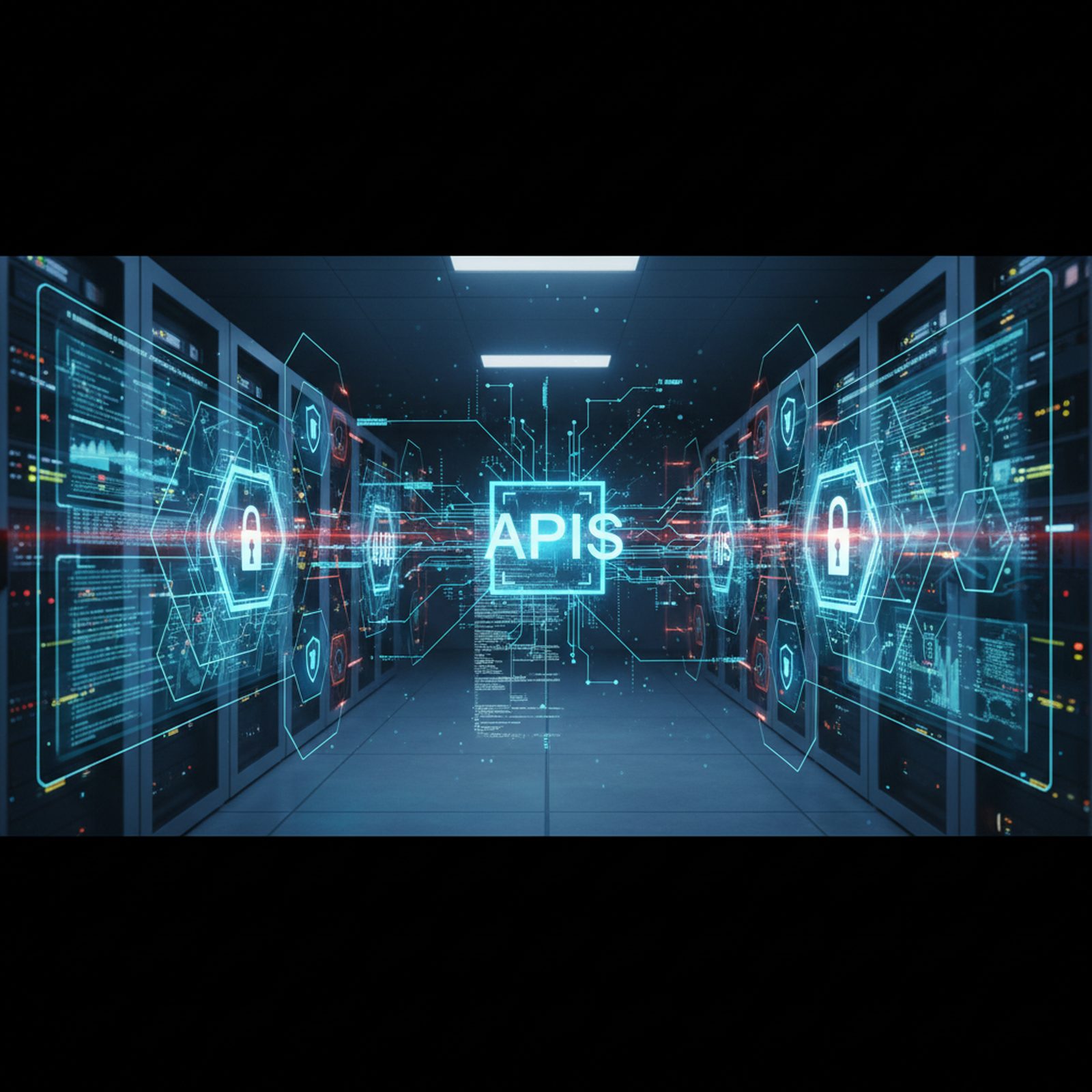
APIs establish themselves as one of the critical points of digital security
The digital economy relies on APIs to connect services, but weak authentication or incorrect authorisation can expose data on a massive scale.
News summary
Modern applications rarely operate in isolation. A website queries a customer system, a mobile app accesses orders, a payment platform validates transactions, and an artificial intelligence service consumes corporate data. A large part of these connections occurs through APIs, making them an increasingly significant target.
Problems do not always stem from sophisticated flaws. An API can be technically protected and yet still allow a user to view information that does not belong to them due to poorly designed authorisation. Old endpoints that remain published, keys embedded in code, or insufficient consumption limits that facilitate abuse and mass data extraction also appear.
API security begins with an inventory. Many organisations do not have a complete list of which interfaces are exposed, who consumes them, and what information they process. Without that visibility, it is difficult to apply coherent controls.
Then come robust authentication, object and function-level authorisation, input validation, rate limiting, and detailed logging. In cloud environments, API gateways and identity services can facilitate many of these tasks, provided they are correctly configured.
It is also important to integrate security testing into development. Detecting a problem before publishing an API is usually much cheaper than fixing it once it is already being used by customers or partners.
It is also advisable to differentiate between public, internal, and partner-facing APIs. Each type requires different controls and expectations. Maintaining clear documentation and owners makes it easier to retire old versions and respond quickly when a vulnerability appears. Security improves significantly when no API is left “ownerless”.
Why this matters to a company operating in Spain
The threat landscape affecting Spanish companies no longer distinguishes by size. Attacks are automated, sold as a service, and seek the shortest path: a reused credential, an unpatched server, or a provider with poorly controlled remote access. For an SME, the difference between a minor scare and a multi-day shutdown almost always depends on decisions made before the incident.
That is why every industry update should be read in operational terms: which specific controls would have prevented the problem, what evidence must be preserved, and who makes the decision when the clock is ticking. This is the approach we apply to managed cybersecurity projects at Seintec.
Real business impact
Before deciding on an investment, it is advisable to identify what is at stake. In cybersecurity projects, we typically review these four areas with management and the IT manager:
- Operational disruption: orders, invoicing, or production halted while systems are restored.
- Loss or exposure of personal data, with a mandatory 72-hour notification requirement to the AEPD.
- Hidden cost of recovery: overtime, external hiring, and loss of client trust.
- Contractual and compliance requirements (ENS, NIS2, ISO 27001) that demand evidence, not intentions.
Five-step action plan
A useful plan fits on one page. This is the roadmap we apply with our clients to move from news to measurable improvement, without disrupting daily operations:
- Inventory: identifying which systems, data, and providers are involved. Without an inventory, prioritisation is impossible.
- Assess the risk and the cost of doing nothing, in terms of downtime hours and euros.
- Defining the measurable objective: availability, response time, monthly cost, or compliance level.
- Implement in phases, starting with the system whose failure would hurt the business most.
- Verify with real testing and review indicators every quarter.
Key indicators you should be measuring
What is not measured is not managed. These indicators allow you to verify if the technological investment is yielding results and serve as the basis for the periodic reports we deliver to our clients:
- Mean time to detection (MTTD) and mean time to response (MTTR) for incidents.
- Percentage of endpoints with up-to-date patching and active EDR.
- MFA coverage for remote access and privileged accounts.
- Backup restorations verified within the last 90 days.
How we approach it at Seintec: Cybersecurity
We shield your company so it never stops. We operate from our own datacenter in Spain, with a certified technical team and a single point of contact who knows your infrastructure, so you do not have to explain your environment every time an incident arises.
These are the capabilities we bring to the table in a cybersecurity project:
- EDR / XDR: Advanced detection and response across endpoints and network.
- UTM perimeter security: Managed firewall and segmentation.
- Email filtering: Phishing, spam, and spoofing blocking.
- WAF: Protection of published applications and services.
- Immutable backup: Backups that ransomware cannot alter.
- MFA and identity: Conditional access based on user and device.
What you gain by working with a technology partner
Outsourcing does not mean losing control: it means gaining predictability, coverage, and independent technical insight. These are the benefits our clients highlight:
- Total prevent–detect–respond coverage: Immutable backup, email filtering, WAF, EDR/XDR, and UTM perimeter security in a single managed contract.
- Ensured continuity: Regain full control of your infrastructure in the event of a cyber incident in less than 4 hours.
- Zero Trust by design: Identity-based access control and MFA for any user and device.
- AI-powered defence: Machine learning engines that monitor endpoints and networks in real time and reduce the mean time to detection.
Frequently asked questions
- How do I know if my company is truly protected?
- With evidence: EDR coverage, two-factor authentication on all remote access, immutable copies, and a recently tested restoration. If any of these four points are not confirmed, there is a real risk of prolonged downtime.
- Where should a company wanting to address cybersecurity begin?
- With an audit of the current environment. At Seintec, we perform an initial no-cost review that identifies risks, dependencies, and priorities, resulting in a phased plan with fixed deadlines and budgets.
- Is it necessary to halt business operations during the project?
- No. We plan migrations and changes within agreed windows, with prior pilot tests and rollback options, ensuring disruption is minimal or non-existent for users.
- What type of companies do you serve?
- SMEs and mid-market companies in sectors such as industry, automotive, logistics, retail, legal, and healthcare, with both on-premises and hybrid cloud infrastructure.
- What coverage and response times (SLA) do you offer?
- Support from Monday to Friday, 09:00 to 18:00, and 24x7 emergencies 365 days a year, with a committed response SLA and a 99.98% service SLA in 2025.
Seintec can help you discover, organise, and protect your organisation’s APIs, both in bespoke developments and cloud architectures. If your applications are increasingly connected and you want to know where the risk may lie, contact us and we will review it with you.
Contact SeintecRelated service
Cybersecurity
We shield your company so it never stops.